

Measuring AI’s Impact on Jobs: A Study on Singapore and China

Background
AI and large language models (LLMs) are transforming labour markets worldwide. Yet there is limited rigorous evidence on how these technologies affect specific occupations and tasks, particularly in Asia, with existing studies focused largely on Western economies.
This project examines AI’s impact on labour markets in Singapore and China, which offer a compelling comparative setting due to their contrasting economic structures, occupational compositions and stages of AI adoption.
The research is motivated by three core questions:
- How can we rigorously measure the impact of AI on different occupations, labour demand and the most vulnerable worker groups?
- How do differences in economic structures and institutions lead to different AI impacts across labour markets in different countries?
- How can we design effective, evidence-based public policies to enhance workforce resilience in the face of AI-driven change?
Developing the AI-LLM Exposure Index
To answer the questions, the project developed Singapore’s first AI-LLM Exposure Index, a measurement tool that analyses real job postings and workplace tasks to identify which occupations are most exposed to AI-driven change.
The AI-LLM Exposure Index works as follows. First, data on millions of occupations and their associated tasks are collected. Each task is then compared with the capabilities of current AI and LLMs (i.e. how much of the task AI could perform today?) and assigned a score — for example, 2 if AI can perform the task and 0 if it cannot. The task-level scores are then aggregated to produce an overall Exposure Score for each occupation. A higher Exposure Score indicates a greater potential for the job to be affected by AI.
The Index also tracks how labour markets are changing over time, including shifts in hiring patterns and educational needs.
Results
In Singapore and China, the jobs most affected by AI are higher-skilled, white-collar occupations, with significant implications for wages, job demand and evolving skills requirements.
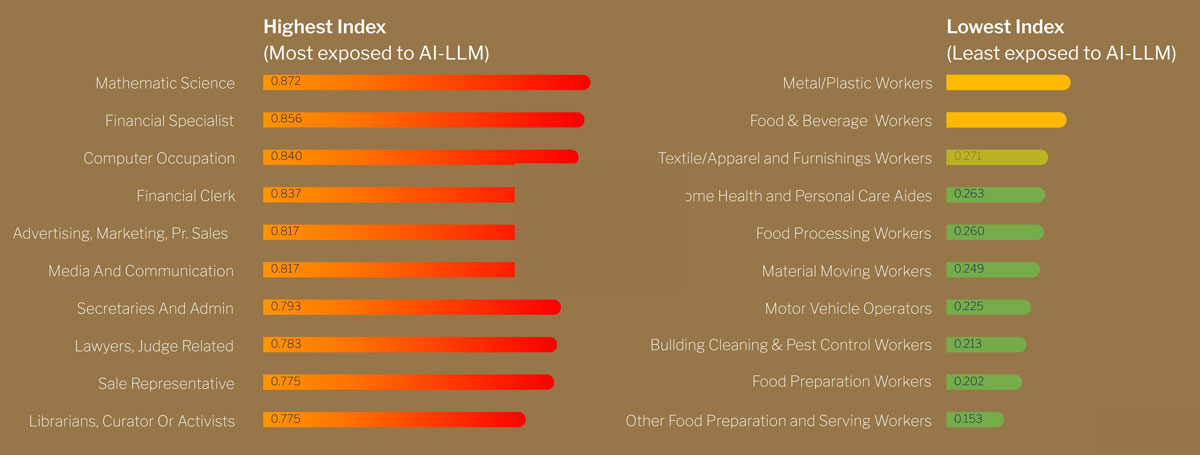
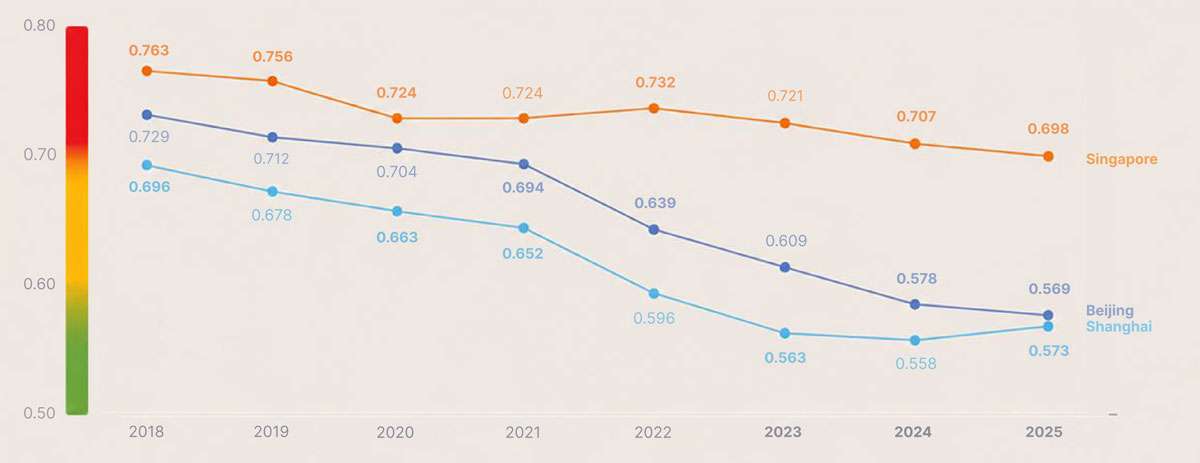
The AI-LLM Exposure Index has tracked occupation data in Singapore, Beijing and Shanghai every month since 2012.
An excerpt of 2018–2025 data shows that jobs in Singapore are more exposed to AI than those in Beijing and Shanghai — this is driven by differences in occupation types across the three cities’ changing labour markets.
Policy Applications
By measuring both the disruptive and enabling effects of AI on the labour market, the Index has real-world applications across various domains and can offer practical insights for reskilling, workforce planning and employability. Here are some of the ways it can be applied.
- Early Warning Systems — establishing continuous labour market monitoring frameworks to provide timely, forward-looking warnings of AI-driven disruptions to specific occupations and sectors.
- Targeted Training — using the task-level exposure data to inform skill adaptation strategies and design reskilling programmes tailored to occupation- and task-specific exposure levels.
- Social Safety Nets — strengthening social protection systems to absorb shocks and support worker transitions in occupations most affected by AI.
- Cross-city Benchmarking — applying the Index to other cities and economies to assess AI’s impact on local labour markets, supporting more targeted workforce strategies in diverse urban contexts.
Conclusion
Lead researcher Professor Li Jia says: “This project provides an evidence-based understanding of how AI is reshaping occupations and skills in Singapore and China through an AI-LLM exposure study. By doing so, policymakers, educators and employers can respond to AI-driven disruption with data rather than guesswork. Discussions are underway with SkillsFuture Singapore to explore a partnership to operationalise the findings.”
Lead Researcher:
Li Jia
Dean, SMU School of Economics;
Lee Kong Chian Professor of Economics, Lee Kong Chian School of Business;
Econometrics Lead, SMU Urban Institute;
Pillar Lead, Maximising Societal Human Capital, SMU Resilient Workforces (ResWORK) Institute
Collaborator:
- Zhang Dandan, Professor in Economics, National School of Development, Peking University
Funding organisation: SMU Resilient Workforces Institute
Read more about this study: Measuring the impact of AI and Large Language Models on Singapore’s labour market: constructing a task-level exposure index
Source: Article from SMU City Perspectives (World Cities Summit 2026) 14-16 June 2026
Featuring: Professor Li Jia (Pillar Lead, Maximising Societal Human Capital)