

ResWORK Seminar on 13 Mar 2026: A Strategic Perspective on Organizational Resilience
Date & Time: 13 Mar 2026, Friday, 2-3.30pm
Venue: SMU Lee Kong Chian School of Business, Seminar Room 3-3 (Level 3), 50 Stamford Road, Singapore 178899
About the talk:
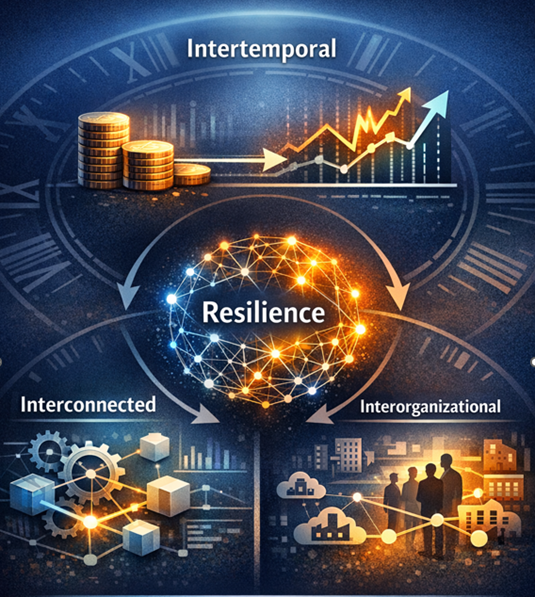
Resilience is widely celebrated, multiply defined, however rarely treated as a strategic choice with real opportunity costs. This paper argues that organizational resilience becomes distinctly strategic when it is shaped by interdependence, namely across time, across organizational actions, and across actors, so that choices made to withstand disruption create commitments, interactions, and spillovers that cannot be evaluated in isolation. Taking resilience to be reflected in realized post-shock performance trajectories, I shift attention from ideological pursuit of “building resilience” toward the conditions under which resilience is worth pursuing. I propose that resilience is strategically consequential in three ways. First, resilience entails intertemporal interdependence because many resilience-relevant choices, such as maintaining slack, modularity, liquidity, or stakeholder commitments, impose costs in stable periods while yielding benefits only under uncertain disruptions. This makes resilience a problem of commitment under uncertainty, sometimes producing tradeoffs and sometimes generating dividends across states. Second, resilience entails interdependence across actions because it typically arises from systems of interacting choices rather than isolated practices. Apparent “bundles” of resilience practices may reflect genuine complementarities or may instead be induced by shared constraints, implying different theoretical interpretations and empirical expectations. Third, resilience entails interdependence across actors because resilience at the focal organization level may depend on how disruptions and responses are distributed across partners, stakeholders, and ecosystems, whether resilience is jointly produced through coordination or achieved by shifting risk outward. By conceptualizing resilience through these interdependence structures, this paper reframes resilience as a problem of commitment, system design, and distribution under disruption, and outlines a research agenda for strategic management that is attentive to tradeoffs, configurations, and cross-actor consequences.
This seminar is suitable for academics, business leaders, and professionals interested in strategy, organizational resilience, and managing uncertainty. It is also consultants and graduate students seeking fresh perspectives on resilience as a strategic choice.
SPEAKER
Ekin Ilseven
Assistant Professor of Strategy and Organizations, School of Business and Economics, Católica-Lisbon
Ekin Ilseven is an Assistant Professor of Strategy and Organizations at Católica-Lisbon School of Business and Economics. He received his MSc in Physics from ETH Zurich (Switzerland) and a PhD in Management from INSEAD (France). His research addresses how organizations can be designed to be resilient against unexpected adversities and investigates the strategic trade-offs occurring in the process. For this, he relies particularly on formal modelling, simulations, and ML/AI techniques in data analysis. His research has been published in Strategic Management Journal and Journal of Organization Design. He further advised local municipalities in Turkey on building disaster resilience, contributes regularly to online outlets such as Drucker Forum Blog, INSEAD Knowledge, and Portuguese national news outlet Renascença, and collaborates with the Global Peter Drucker Forum and Agile Thinkers of Lisbon, ensuring delivery of rigorous research to business communities and governance around the world.
MODERATOR
Arianna Marchetti
Assistant Professor of Strategy & Entrepreneurship, Lee Kong Chian School of Business, ResWORK Fellow, SMU
Arianna Marchetti is an Assistant Professor of Strategy & Entrepreneurship at Singapore Management University. Her research examines how organizations structure themselves for effective coordination and cooperation, with a specific focus on human-AI collaboration design. Her work has been published in journals such as Management Science, Strategic Management Journal, Journal of Management, and Humanities & Social Sciences Communications. Prior to joining SMU, she was a faculty member at London Business School, where she taught Strategy Analytics. Arianna also gained industry experience as a Consultant for EY in Italy earlier in her career. She earned her PhD in Management from INSEAD and holds both a Bachelor’s and Master’s degree in Industrial Engineering from Sapienza University in Rome.