

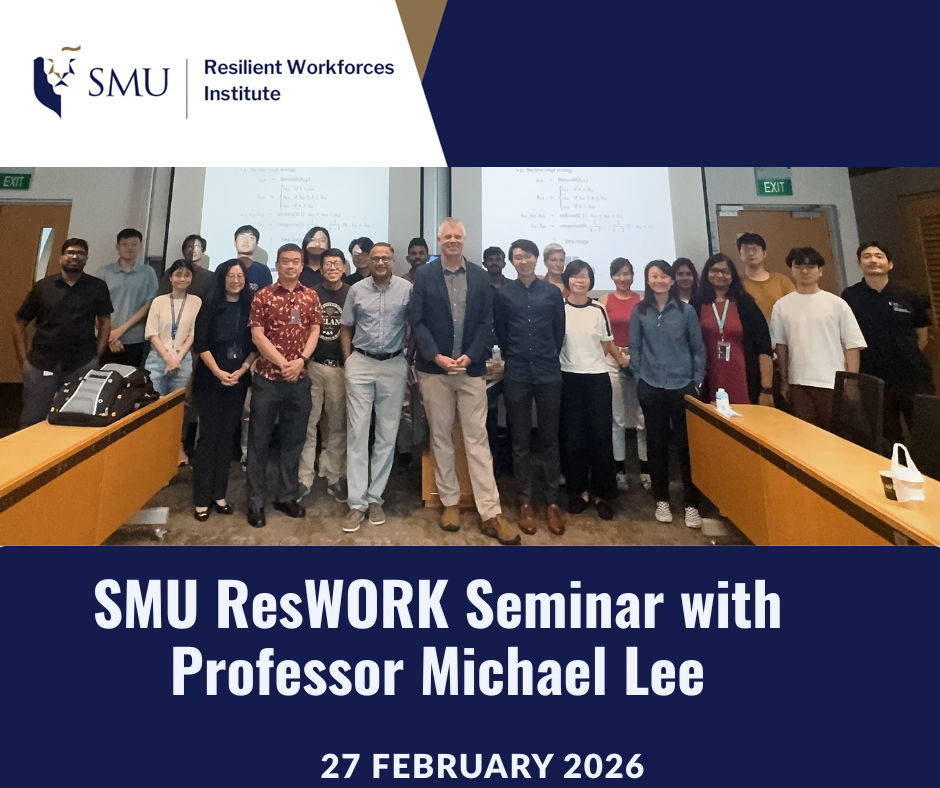
ResWORK Seminar by Professor Michael Lee on 27 February 2026
Seminar: Examples of Bayesian Cognitive Modeling in Learning, Memory, and Decision Making
Bayesian cognitive modeling provides a framework for developing, evaluating, and using probabilistic generative models of human cognition and behavior. We present three examples that demonstrate different advantages of the approach. In a first decision making example, we study how people solve the optimal stopping problem of purchasing airline flight tickets when prices fluctuate as the day of travel approaches. We identify individual differences in the decision strategies that people use. In a second memory example, we develop a cognitive measurement model for the mnemonic similarity task, which is widely used in clinical assessment. The cognitive model allows inferences to be made about the function of people's memories, and the response strategies they use when their memory fails. We show that the model-based approach is better than simple behavioral measures at detecting memory impairment and neuropsychological deficiencies. In a final learning example, we propose a new model of category learning in which the assignment of stimuli to categories is continually mentally updated, rather than only being adjusted when stimuli are encountered. We motivate the model with empirical results showing the dynamics of category learning in environments that change based on people's behavior, and demonstrate the model on a classic category learning task. Throughout these examples, we emphasize how the founding principle of Bayesian analysis -- the coherent management of uncertainty and rational incorporation of available information --- allow the freedom for creative model development while maintaining the standards of rigorous model evaluation.
Speaker: Michael Lee, Professor, Department of Cognitive Sciences, School of Social Sciences, University of California, Irvine; SMU ResWORK Visiting Professor
Professor Michael Lee is a Professor of Cognitive Sciences and currently a Chancellor's Fellow at the University of California, Irvine. He is a former President of the Society of Mathematical Psychology, a winner of the William K Estes Early Career Award, and a two-time winner of the R Duncan Luce Best Paper Award from that Society. His research involves the development, evaluation, and application of models of cognition including representation, memory, learning, and decision making, with a special focus on individual differences and collective cognition. His research emphasizes the use of naturally occurring behavioral data, and tries to pursue a solution-oriented approach to empirical science, in which the research questions are generated from real-world problems. His research methods focus on probabilistic generative modeling and Bayesian methods of computational analysis.